
Your pipe burst, so you grabbed the big yellow book off the shelf, flicked to "Plumbers", and rang whoever had the biggest ad. The business with the most space on the page got the call.
Then came Google. You typed "plumber near me", got ten blue links, opened three of them in new tabs, and called the one whose website looked most trustworthy. The business at the top of the page got the call.
Now? You ask a robot.
"Who's the best plumber near me for a burst pipe, open on a Sunday?" ChatGPT, Gemini, or Google's AI reads the websites for you, compares them, and hands you two or three names. You never open a single tab.

The business in the AI's answer gets the call.
What happens if you're not part of the robot conversation?
You don't exist to that buyer.
They never see your website. They never compare your prices. They never read your reviews. The AI gave them a short list, and you weren't on it.
I saw this first-hand when I bought a curved monitor recently. Google's AI recommended a few models, built a table comparing them against what I needed, and I made my decision. I only visited one website, right at the end, to check the reviews of the one I'd already picked.
Every business that wasn't in that answer never had a chance. And none of them will ever know they lost the sale.
That's the scary part. You can't see the buyers you're missing. But you can see the signs.
The first sign: your organic traffic has dropped
If you've noticed fewer people finding your website through Google, you're not imagining it.
More and more searches now end on the results page. Google's AI Overviews answer the question at the top, and people never click through. It's called zero-click search. Your website might even be one of the sources the AI used to write the answer. You did the work. You just didn't get the visit.
The good news: you can check this yourself in a few minutes.
Check 1: Is Google showing you, but people aren't clicking?
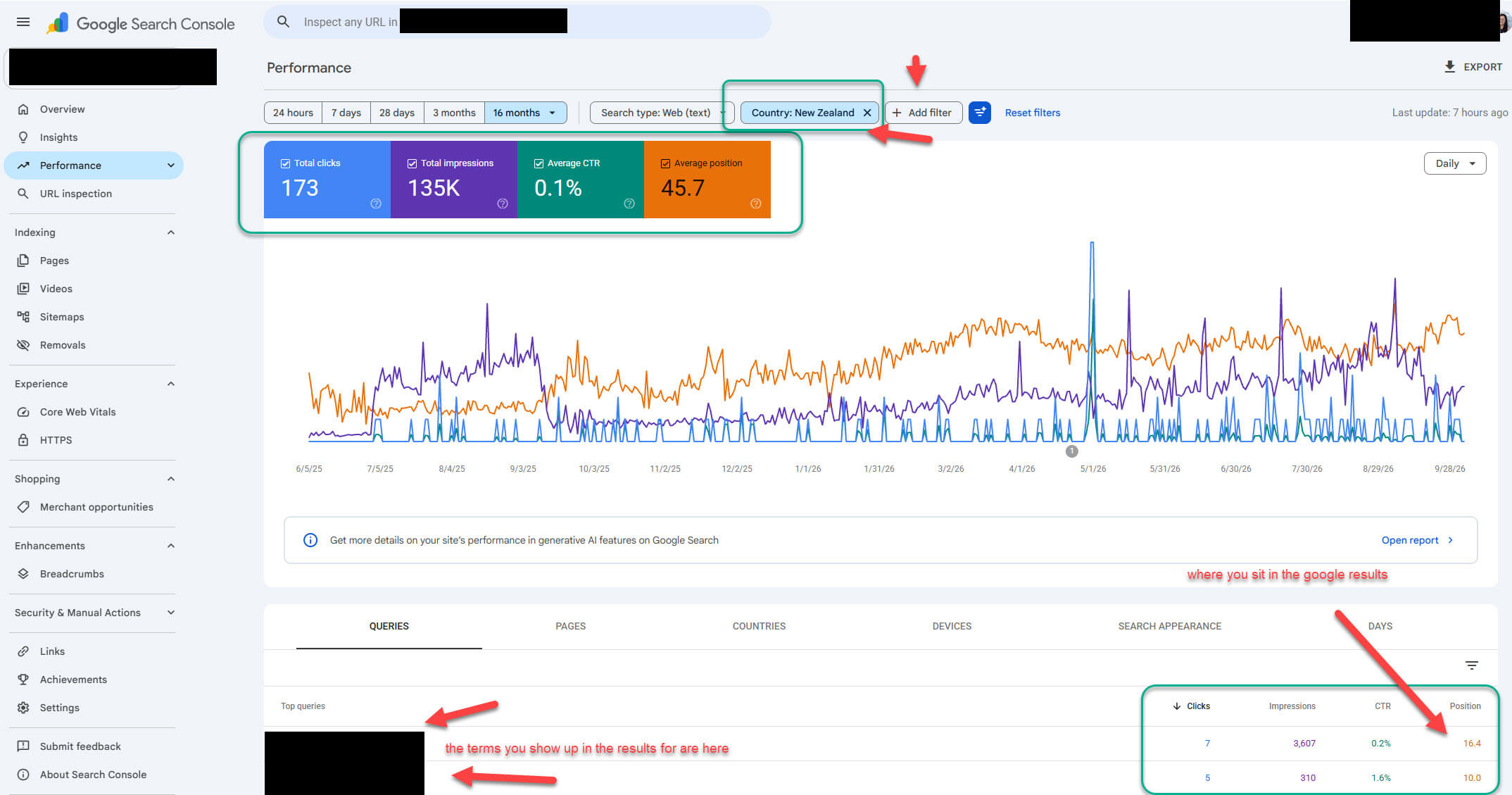
Open Google Search Console and go to Performance, then Search results.
Tick all four boxes at the top: Total clicks, Total impressions, Average CTR, and Average position. Set the date range to the last 16 months, so you can see the change over time.
Now look at the lines:
- Impressions are how often your website appeared in Google.
- Clicks are how often someone actually visited.
- CTR (click-through rate) is the percentage of people who saw you and clicked.
What it means
- Impressions steady or rising, but clicks and CTR falling: Google is still showing your business, but people are getting their answer without clicking. This is the AI effect. You're being read, not visited.
- Impressions and clicks both falling: Google is showing you less. That's usually a different problem, like a Google update or a technical issue. Read why your website traffic has dropped.
- Both steady or rising: good news. Keep an eye on it.
Check 2: Is Google using you in its AI answers?
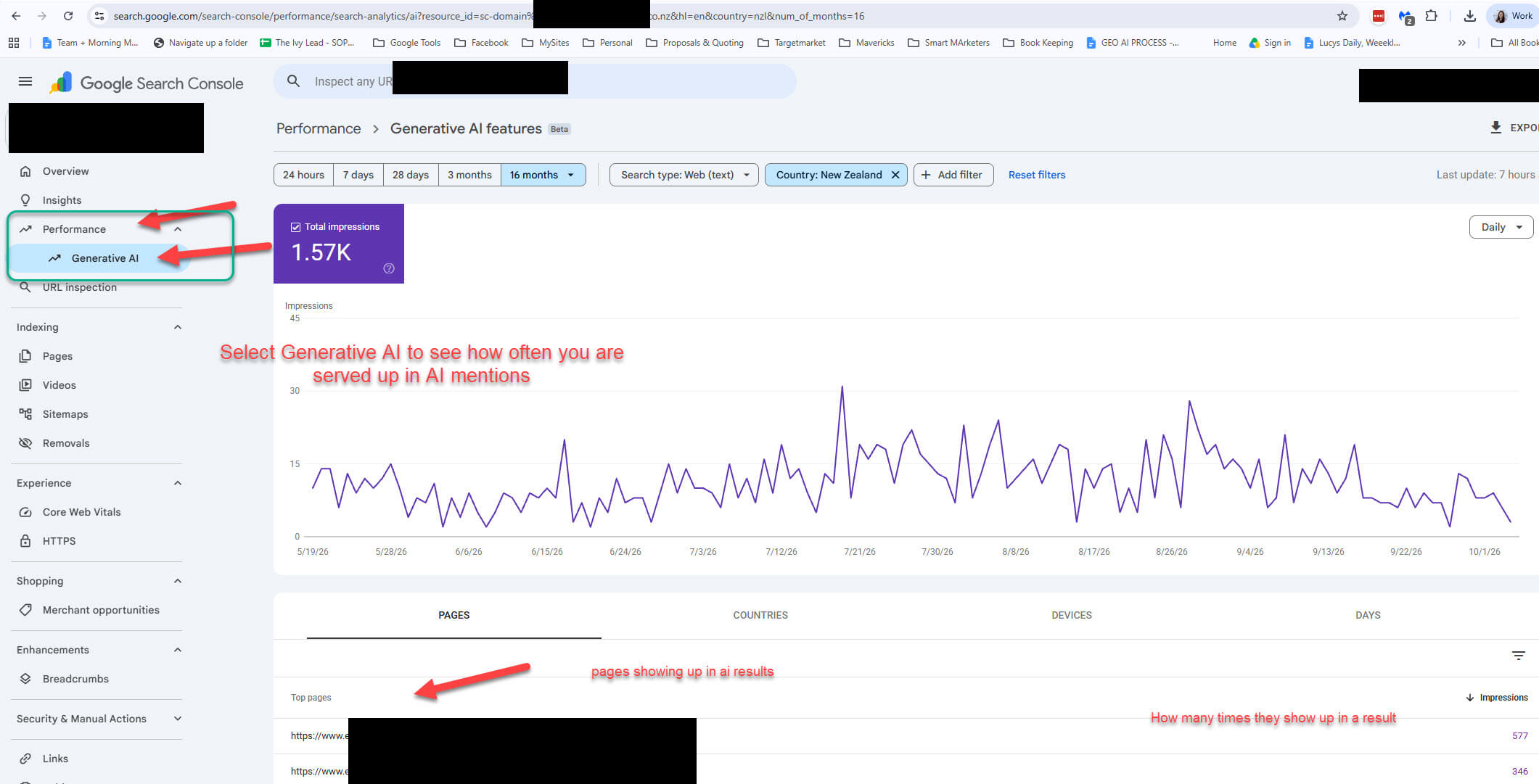
In 2026, Google added a new Generative AI performance report to Search Console. It shows how often your pages appear in AI Overviews and AI Mode, Google's AI answers.
Go to Performance and look for Generative AI in the menu. It's still rolling out, so not every website has it yet. If you can't see it, check again in a few weeks.
What it means
- Plenty of AI impressions: Google trusts your content enough to use it in AI answers. Check which pages are being used, and whether they're the pages that bring you business.
- Few or no AI impressions: Google isn't using your website in its AI answers. When buyers ask Google's AI about what you do, you're not part of the conversation.
One thing to know: this report shows how often you appeared, not how many people clicked. It tells you whether you're in the conversation, not what it's worth yet.
Check 3: Are AI tools sending you visitors?
Some people do click through from AI tools to your website. Google Analytics can show you how many.
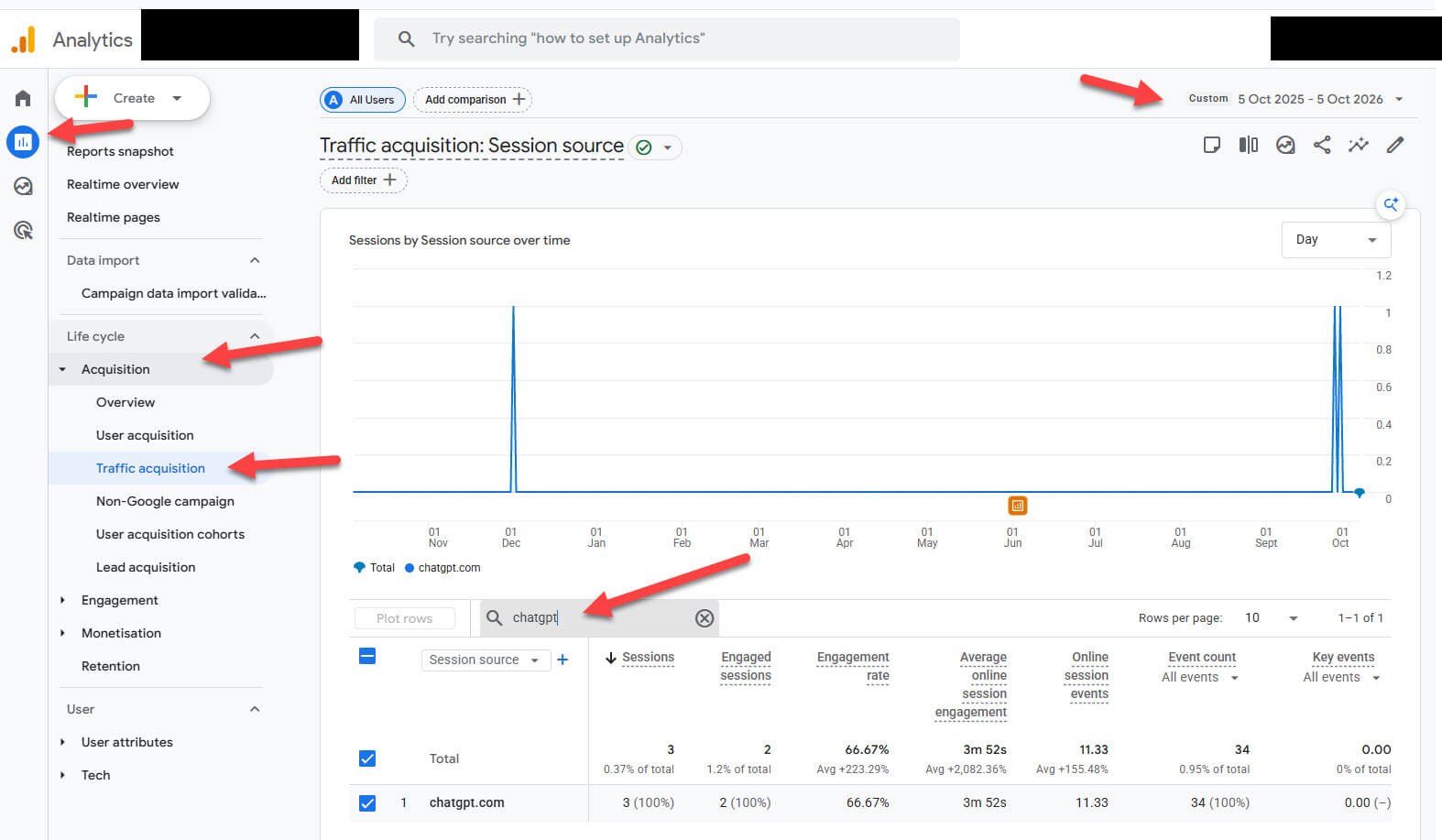
Open Google Analytics and go to Reports, then Acquisition, then Traffic acquisition. Change the first column to Session source. Then type each of these into the search box, one at a time:
- chatgpt
- perplexity
- gemini
- copilot
- claude
Set the date range to the last 12 months and compare it with the 12 months before.
What it means
- No visitors from AI tools: AI isn't recommending your business, or not often enough for people to click.
- A few visitors, flat over time: you're showing up occasionally. There's room to grow.
- Visitors growing month on month: you're part of the conversation. Now make sure the pages they land on turn them into enquiries.
These numbers are a floor, not a ceiling. Some AI visits show up as "direct" in Google Analytics because the AI tool doesn't always pass on where the visitor came from. The real number is likely higher.
So, what did you find?
If your clicks are falling, your AI impressions are low, and AI tools aren't sending you visitors, you're not part of the robot conversation yet.
That's fixable. But it's not fixed by writing more blogs or spending more on ads.
AI tools recommend businesses they can find, understand, and trust. That comes down to how your website is built and written, how clearly it answers the questions buyers ask, and what the rest of the internet says about you.
AI SEO: get found by robots and by Google
This is what our AI SEO service does. You might also hear it called AEO (answer engine optimisation) or GEO (generative engine optimisation). Same idea: making your business easy for AI tools to find, understand, and recommend.
And here's the bonus. The things that help AI tools trust your business are the same things Google has always rewarded: clear pages, real answers, a website that's technically sound, and proof you're a real, active business. So AI SEO doesn't replace traditional SEO. It makes it stronger.
A commercial furniture supplier in Australia and New Zealand we work with went from 90 visitors a year from AI tools to 598, and from 6 enquiries to 50, over 12 months.
It doesn't happen overnight. Most businesses see early signs in the first few months, and real momentum between months 3 and 6. We don't promise rankings or AI mentions. Nobody honestly can. We promise the work, not the outcome.
We work with service businesses across New Zealand and Australia.